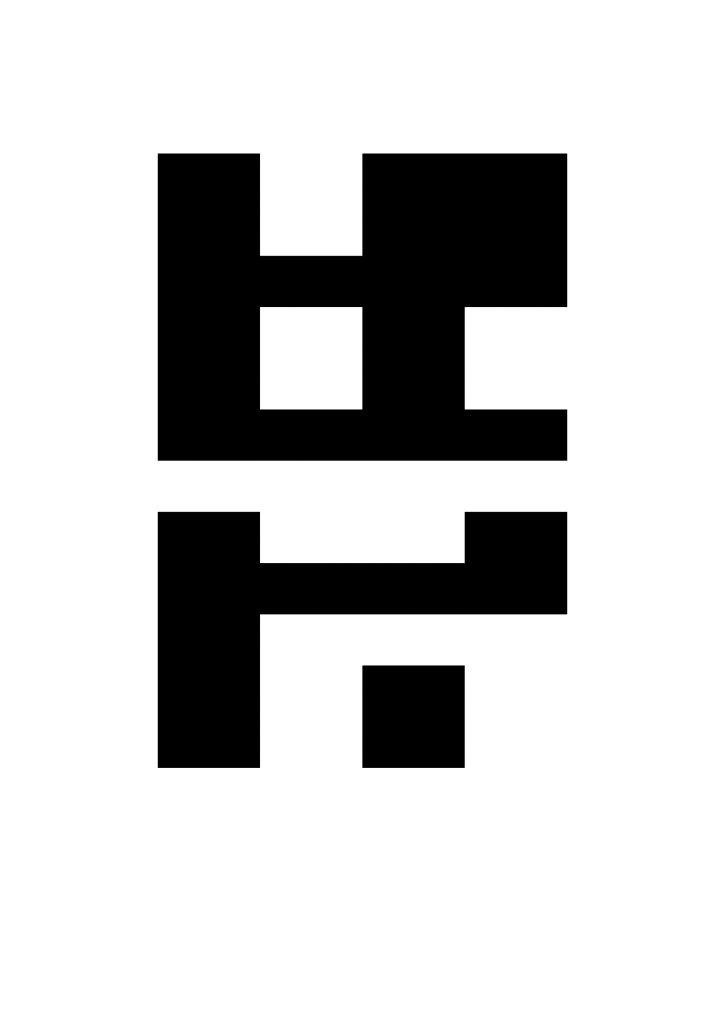
SHEET NINETEEN

book contet
PART ONE | the task roulette:
  1. WATCH AN OLD BLACK AND WHITE MOVIE.
  2. WRITE A POEM ABOUT A BIG, BLUE, BOUNCY BALL.
  3. BUY A BOX OF CHOCOLATE AND SHARE IT WITH A FRIEND.
PART TWO | how I solved it:

+ 6 rows and 3 columns table with a cell of 6 units height and 6 units width. Centred.
+ The drawing grid imitates the actual grid of the selected chocolate bar; each cell equals to one slice of the chocolate.


THE DRAWING

+ To stay as close to randomness as possible my friend here, to whom I offered the chocolate was the random sequence generator at random.org (but in the end it was me eating up all the pieces 🙂 )
+ First all the cells were randomly numbered with the help of the mentioned generator. Then a new random list of only 9 numbers between 1 and 18 was selected using the same random generator.


+ THESE numbers represented the cells or chocolate slices I was able to eat away. And thus the final drawing shows those cells or chocolate slices that stayed untouched during the task.

PART THREE | few samples:
CHECK OUT ALL THE 18 IMAGES
SCROLL THROUGH THE BOOKS

SHEET EIGHTEEN

book contet
PART ONE | the task roulette:
  1. GO TO THE SHOOTING RANGE.
PART TWO | how I solved it:

+ 2 rows and 2 columns table with a cell of 10 units height and 10 units width. Centred.
+ Each cell represents one set of 10 shots.


THE DRAWING

+ To mimic a shooting target the base-grid was divided into 10 evenly spaced concentric rings/squares, with score values from 10 through 100 (rising by 10 points towards the centre).
+ Using a shooting simulator at www.hlberg.dk/eurosimulator I made my 4 rounds of 10 shots for each drawing, and recorded the scores that I achieved.


+ FOR the drawing, these results were marked accordingly into my base-grid, to draw a square shape with matching side lengths.
+ However, the final drawing is an inverse picture of the received shape: the achieved result is white, while the rest of the ‘ shooting target’ – square is painted black.
+ The first round is depicted in upper left cell, the second in the upper right cell, the third in the bottom left and the last one in the bottom right cell.

PART THREE | few samples:
CHECK OUT ALL THE 18 IMAGES
SCROLL THROUGH THE BOOKS

SHEET SEVENTEEN

book contet
PART ONE | the task roulette:
  1. GO TO A HIGH END FURNITURE STORE AND DREAM.
  2. HAVE A SÉANCE.
  3. COUNT ALL THE CHANGE THAT YOU HAVE IN YOUR COIN BANK.
PART TWO | how I solved it:

+ 20 rows and 14 columns table with a cell of 2 units height and 2 units width.
(This grid actually covers the whole page of the notebook I am using for the project).


THE DRAWING

+ The grid used in the book was proportionally transcribed onto a sheet of A3 paper, and attached to a flat surface (to the ground). Then I opened my wallet and let the coins fall onto the surface. (Same amount of coins, same height, and a same position was used for each book; at least I tried my best).
+ The coins rolling out the grid-paper were not considered for the final drawing.


+ The drawing is showing the final position of dropped coins within the used grid; each cell that is touched by a coin is painted black.

PART THREE | few samples:
CHECK OUT ALL THE 18 IMAGES
SCROLL THROUGH THE BOOKS

SHEET SIXTEEN

book contet
PART ONE | the task roulette:
  1. GO TO THE ARCADE AND PLAY SKEEBALL. SEE WHO GETS THE MOST TICKETS.
PART TWO | how I solved it:

+ 4 rows and 4 columns table with a cell of 6 units height and 4 units width,
+ 6 units from the top edge, vertically centred.
+ Each cell represent one repetition of the assigned task.


THE DRAWING

+ The required game is not popular or available here, so I created something similar to skeeball. The object of my game was to get a small (tennis) ball into one of the three provided baskets, placed beneath the inclined lane.
+  I had one go for each cell; unless none of the baskets was hit, then I could do a second try.


CORRESPONDING with the game set up, each cell of the base-grid is vertically divided into 3 equal parts; each box represents one of the three baskets used.
+ Starting in the upper left cell, and working across to the right; for each drawing I rolled the ball 16 times up the inclined lane, and recorded if and which of the three baskets did I managed to hit:
If the ball stopped in the basket nearest to the desk, the bottom third of the cell is painted black. For the middle basket, two-thirds of the cell is painted black. If the one farthest is hit, the whole cell is painted black. For the missed balls, the cell stayed blank/white.

PART THREE | few samples:
CHECK OUT ALL THE 18 IMAGES
SCROLL THROUGH THE BOOKS

SHEET FIFTEEN

book contet
PART ONE | the task roulette:
  1. CREATE YOUR OWN FUNNY BUSINESS CARD ONLINE.
  2. DO THE CRAB CRAWL THROUGH YOUR HOUSE.
  3. GO TWILIGHT BOWLING.
PART TWO | how I solved it:

+ 2 rows and 2 columns table with a cell of 12 units height and 14 units width. Centred.
+ Inside each cell of the base grid, there is another 4 rows and 7 columns table, with a cell of 3 units height and 2 units width. However, from all the 28 cells only those are used for the drawing that, according to the ground plan correspond to the actual layout of the bowling pins. Where the front pin is always on the horizontal centre line of the base-grid, or with other words the bottom two bowling tables are a mirror image of the upper two ones.


THE DRAWING

+ (… I was really keen to go out, but there is no bowling place at my town any longer.) At gamesgames.com I played 4 bowling rounds for each drawing image or book, and painted black the cells of those pins knocked down on the first roll; the pins knocked over on the second shot were not considered.
+ First round is in the upper left cell, second in the upper right cell, third in the bottom left and the last one in the bottom right cell.

PART THREE | few samples:
CHECK OUT ALL THE 18 IMAGES
SCROLL THROUGH THE BOOKS

SHEET FOURTEEN

book contet
PART ONE | the task roulette:
  1. GO TO THE COUNTRY FAIR.
  2. GO TO A CONCERT.
  3. PLAY CROQUET WITH ONIONS.
PART TWO | how I solved it:

+ 3 rows and 2 columns table with a cell of 12 units height and 12 units width. Centred.
+ Each cell represents one of the 6 repetitions of the assigned task.


THE DRAWING

+ I played something similar to croquet; using 4 plastic petanque balls and a hammer. The objective of the game was to get the ball into the goal with no more than four strokes. The balls were hit with a hammer.

+ Each cell of the base table was further divided into 4 columns to correspond to the 4 balls I was playing with; where the leftmost represents the first of the 4 balls per round and the rightmost the last, fourth ball.
+ These columns are furthermore vertically divided into 4 equal parts, corresponding to the number of strokes I needed to get the ball into the goal; the number rises bottom-up.


+ STARTING in the upper left cell, and working across to the right; in each column only that one cell was painted black that corresponds to the achieved result. If more than 4 strokes were needed to get the ball into the goal, the column stayed blank/white.

PART THREE | few samples:
CHECK OUT ALL THE 18 IMAGES
SCROLL THROUGH THE BOOKS

SHEET THIRTEEN

book contet
PART ONE | the task roulette:
  1. GET A SHAVE AT THE BARBER SHOP.
  2. BUILD A BIRD’S NEST OUT OF DRYER LINE AND TWINE.
  3. SEE WHO CAN CATCH THE MOST FIREFLIES.
PART TWO | how I solved it:

+ 3 rows and 2 columns table with a cell of 12 units height and 12 units width. Centred.
+ Each cell represents one round of the made-up bingo like Catch Fireflies game.


THE DRAWING

+ Each cell of the base-grid was further divided into 6 rows, and each row into 6 equal units which makes 36 fields per cell or 36 fireflies per round.
+ Using a dice each field was numbered with a number between 1 and 6.


+ AFTER all the cells of the base-grid were numbered, the dice was thrown one more time separately for each of the 6 cells, to get the so called winning number or the caught firefly; thus the drawing shows all the fields containing the matching number(s) or with other words all the fireflies caught.

PART THREE | few samples:
CHECK OUT ALL THE 18 IMAGES
SCROLL THROUGH THE BOOKS

SHEET TWELVE

book contet
PART ONE | the task roulette:
  1. MAKE YOUR OWN FREE WEBSITE.
  2. ENJOY SOME QUIET TIME AT STARBUKS.
  3. GO TO CHURCH AND LIGHT A CANDLE.
PART TWO | how I solved it:

+ 3 rows and 7 columns table with a cell of 5 units height and 5 units width. 90 degree CCW rotated.
+ Each cell represents one of the candles.


THE DRAWING

+ For this task I used the help of the web page greatfulness.org. Each time I visited the page a new (random) set of 21 burning candles was shown, thus I visited the page once for each book and made a screenshot of the scene i.e. the given candle layout.

final02
+ The round window showing the burning candle is vertically divided into 4 equal parts or levels, and the candles are given points according to their current height. These points determine the length of a square’s side depicted within the corresponding cell; 1 point equals 1 unit.

the unlit candle = 5 points
the one still above the middle line = 4 points
the one under the middle line = 3 points
the one nearly burned out = 2 points


ACCORDINGLY each cell of the table was marked with a score number.
+ Alight with the upper right edge, within each cell there is a black square corresponding to the ‘candle points’ of the current (random) candle set up.

PART THREE | few samples:
CHECK OUT ALL THE 18 IMAGES
SCROLL THROUGH THE BOOKS

SHEET ELEVEN

book contet
PART ONE | the task roulette:
  1. GET A FREE SAMPLE COOKIE AT THE BAKERY.
  2. SEE HOW LONG YOU CAN WALK ON THE BLACKTOP WITHOUT RUNNING TO THE GRASS.
PART TWO | how I solved it:

+ The grid used is the actual grid of the notebook page; 40 rows and 28 columns, where each cell is 1 unit high and 1 unit wide.
+ A stylized shape of the number 8 was depicted (24 units width and 36 units height) to the page of the notebook, with a line of 1 unit thickness. 


THE DRAWING

+ I did try it with walking on the blacktop, but it was somehow not exciting enough to be useful for this image, thus ‘walking a line’ was turned into ‘drawing a line’.
+ I attached a permanent marker with bold/bullet thickness to a 1 meter long stick. My task was to draw a line within the given outline, but I had to do this with a single stroke. I could lift the marker only once, for the middle/horizontal line. (This outline on the wall is identical to the one in the book. However, 90 degree CCW rotated.)


+ THE final image shows all those points (cells) left and/or right from the path outline where my line touches or crosses this outline.

PART THREE | few samples:
CHECK OUT ALL THE 18 IMAGES
SCROLL THROUGH THE BOOKS

SHEET TEN

book contet
PART ONE | the task roulette:
  1. TAKE A WALK IN THE MOONLIGHT. BEWARE OF VAMPIRES AND WEREWOLVES.
  2. GO CRABBING AND CATCH YOURSELF A DINNER.
  3. BUY A USED VIDEO GAME.
PART TWO | how I solved it:

+ 3 rows and 3 columns table with a cell of 8 units height and 8 units width. Centred.
+  Each cell represents one playthrough of the (video) game.


THE DRAWING

+ I didn’t just buy a used video game, but tried to find and play an “outdated” video game we used to play as kids instead:
+ Minesweeper seemed the most suitable for this task.
+ I choose such a version of the game that has a box of 8 by 8 fields, and therefore fits to an individual cell of my drawing grid: www.freeminesweeper.org/minecore.html
+ To define the structure of the drawing the cells of the base-grid were randomly numbered with numbers from 1 to 9 using the sequence generator at http://www.random.org 


+ THUS I played the game 9 times per drawing and copied the state of my game field after ‘game over’ was called, into a cell of the corresponding (serial) number;  starting with the cell number one.
+ The unopened boxes are painted black while the opened ones stay blank/white.

PART THREE | few samples:
CHECK OUT ALL THE 18 IMAGES
SCROLL THROUGH THE BOOKS