sheet two

book contet, RANDOM ORDER VOL. 2
PART ONE | the task roulette:
  1. SEE WHO CAN GET THE MOST PHONE NUMBERS AT THE MALL.
  2. TRY TO WIN ON AN ONLINE PENNY AUCTION SITE.
  3. SET UP CARNIVAL GAMES IN YOUR BACKYARD.
PART TWO | how I solved it:

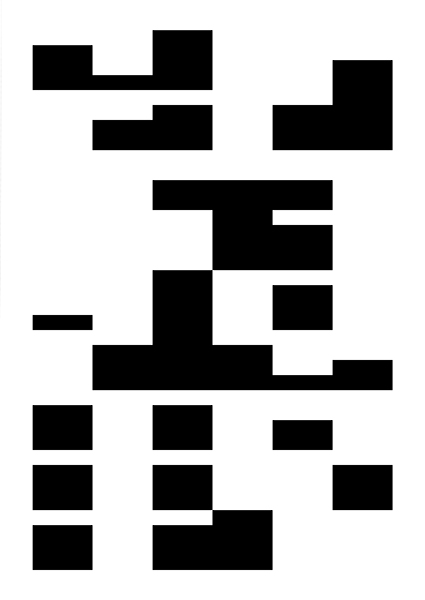
+ 3 tables of 3 rows and 6 columns with a cell of 4 units height and 4 units width. Centred.
+ While each table stands for one of the selected games, the cells represent one of my tryouts to hit the target within the individual game.


THE DRAWING

+ Taking some ideas from the www.carnivalsavers.com web page I created three different “Carnival Games” using the materials found at my studio:


GAME ONE – BALLOON BURST:
+ Corresponding with the drawing table, 18 balloons were attached to a board. The objective of the game was to pop as many balloons as possible (or with other words to pop them all) with 18 shots, using a handmade dart.
+ The drawing image is a transcript of the end stage of the balloon board; the popped balloons with a cell painted black, for the balloons that “survive the attack” the cell stays blank/white.


GAME TWO – RING TOSS:
+I was playing with a spray-paint can and a ring made out of wire. I had 18 tryouts, one for each cell, to toss the ring around a peg.
+ Starting with the upper left cell and proceeding across to the right, if successful the cell is painted black, if not the cell stays blank/white.


GAME THREE – BALL TOSS:
+ Here I used a tennis ball and an empty paint bottle placed to a plinth. The objective of the game was to knock down the bottle. I was given 18 tryouts, one for each cell.
+ Starting with the upper left cell and proceeding across to the right, if successful the cell is painted black, if not the cell stays blank/white.


+ HOWEVER, since this is a random order “game” the final image ie. which table should be used for which game’s results, was specified by the random sequence generator at www.random.org
+ The sequence top down is as follows: game one, game three, game two

PART THREE | the image:
SCROLL THROUGH THE BOOK
GET INVOLVED

sheet one

book contet, RANDOM ORDER VOL. 2
PART ONE | the task roulette:
  1. SING THE JOHN JACOB JINGLEHEIMER SMITH SONG AS FAST AS YOU CAN.
  2. GO TO A DIY CLASS AT HOME DEPOT.
  3. PLAY A FREE ONLINE GAME.
PART TWO | how I solved it:

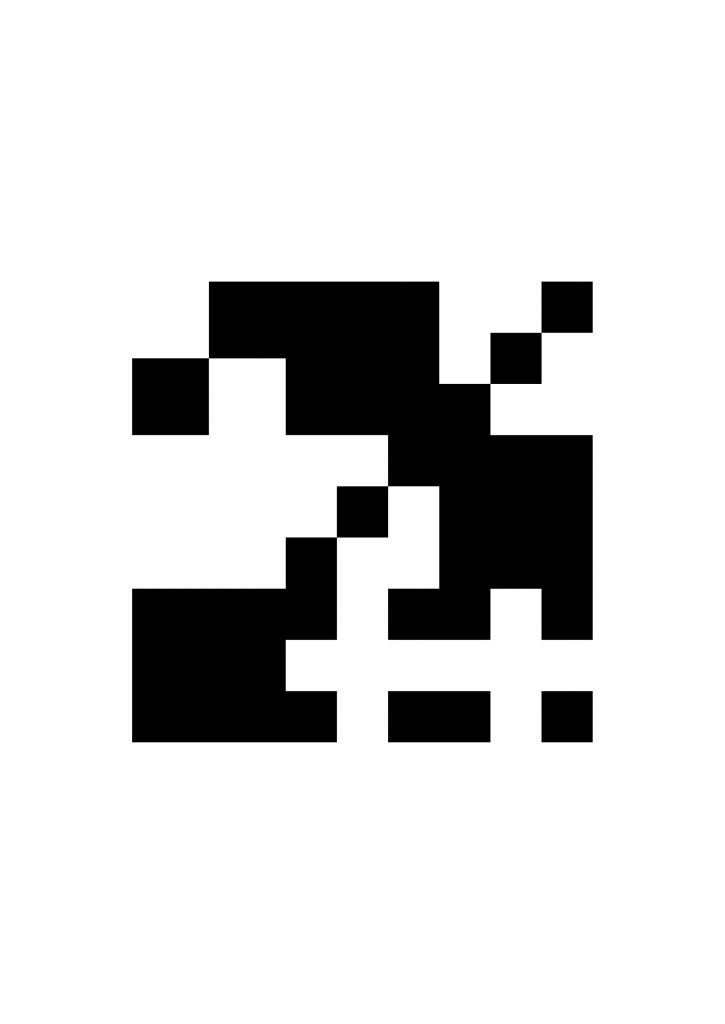
+ 9 rows and 6 columns table with a cell of 4 units height and 4 units width. Centred.
+ Each cell represents one of my tryouts to hit the target. 


THE DRAWING

+ Looking for the appropriate game to play, I ended up at gogy.com, and from all the proposed games Stickman Archery, attracted my attention.

+ The objective of the game is to hit the target and/or collect as many points as possible, while the target “is jumping” to different spots within the game field. The target is a 4 rings target, with score values of 1, 3, 6, and 10; thus my drawing cell was horizontally divided into quarters and painted (bottom up) accordingly:
10 points ranking, the cell is painted black.
6 points hit, three quarters of the cell are painted black.
3 points hit, half of the cell is painted black.
1 point hit, one quarter of the cell is painted black.
For a missed target, the cell stays blank/white.


+ THE drawing image is a transcript of my archery skills. Starting with the upper left cell and working across to the right, each cell is painted depending whether and where the target was hit.
+ I had 1 trial per cell.

PART THREE | the image:


SCROLL THROUGH THE BOOK
GET INVOLVED

SHEET THIRTY-TWO

book contet
PART ONE | the task roulette:
  1. PLAN YOU OWN FUNERAL.
  2. GO TO A DAIRY AND MILK A COW.
  3. PLAY TENNIS WITH YOUR BASEMENT WALL.
PART TWO | how I solved it:

+ 3 rows and 3 columns table with a cell of 6 units height and 6 units width. Centred.
+ The frame corresponds to the »game court« on the wall made from threads, and each cell represents one of the nine playing boxes


THE DRAWING

+ The playing fields were numbered from one to nine, starting at the top left field.
+ My task was to hit with the ball, each of the nine playing boxes in the order from one to nine. I was counting how many balls/punches I needed for each of them. (If I lost the ball during the game I could start again, however the counting continued at the number where I lost the ball.)


+ THE CELLS of the drawing grid were filled accordingly; if the task was reached with a single punch the cell is painted black, for 2 punches the cell is divided into 2 smaller same sized black squares, for 3 punches the cell is divided into 3 smaller same sized black squares, and so on until 6. If more than 6 punches were needed the cell stays blank/white.

PART THREE | few samples:
CHECK OUT ALL THE 18 IMAGES
SCROLL THROUGH THE BOOKS

SHEET THIRTY-ONE

book contet
PART ONE | the task roulette:
  1. WATCH A PAY PER VIEW CONCERT.
  2. WATCH HIGH SCHOOL FIELD HOCKEY PRACTICE.
  3. PLAY SOLITAIRE BUT DON’T CHEAT.
PART TWO | how I solved it:

+ 8 rows and 7 columns table with a cell of 3 units height and 3 units width,
+ 4 units from the right edge, vertically centred.
+ The frame grid is diagonally divided into 2 parts, for the 2 rounds of solitaire I played for each drawing or book. This way the arrangement of the cells corresponds to the layout of the cards at the beginning of the game. (However, the layout of the second game is to be rotated 180 degree, to fit the lower half of the divided grid.)


THE DRAWING

+ For each drawing or book I played 2 rounds of solitaire, and marked the colour of individual playing cards, in the order I opened them during the game, each into their corresponding cell.
+ The first game is marked in the upper half of the grid, while the second round in the lower half.


+ A red card (Diamond or Heart) is marked with a little 1 by 1 unit black square in the middle of the cell; for a black card (Cross or Peak) the cell is painted black. A white/blank cell means the game was over before that card was opened.

PART THREE | few samples:
CHECK OUT ALL THE 18 IMAGES
SCROLL THROUGH THE BOOKS

SHEET THIRTY

book contet
PART ONE | the task roulette:
  1. SPEAK IN SHAKESPEARIAN WAY TO EACH OTHER.
  2. GET NEW WIPER BLADES FOR YOUR CAR.
  3. TRY TO CATCH M&M’S IN YOUR MOUTH.
PART TWO | how I solved it:

+  8 rows and 8 columns table with a cell of 3 units height and 3 units width. Centred.
+ Each cell represents one of the 64 candies I used for a single drawing or book.


THE DRAWING

+ Each colour option of the used chocolate candies (yellow, orange, red, green, blue and brown) was given its visual sign.

+ The drawing net was randomly filed with M&M’s, one bonbon per cell.


+ THEN, starting with the upper left cell and working across to the right, one by one I threw the bonbons up in the air to try and catch them with my mouth. Those I managed were accordingly marked into the grid; the cells of unsuccessful trials were left blank/white. (For each bonbon I had only one trial.)


PART THREE | few samples:
CHECK OUT ALL THE 18 IMAGES
SCROLL THROUGH THE BOOKS

SHEET TWENTY-NINE

book contet
PART ONE | the task roulette:
  1. INVEST IN SOME CHEAP STOCKS.
  2. HAVE A POTLUCK PICNIC AT THE PARK.
  3. BUY SOME BRED AND FEED THE DUCKS IN A POND.
PART TWO | how I solved it:

+ 2 rows and 6 columns table with a cell of 20 units height and 3 units width. Vertically centred.
+ Each cell represents one of the 12 ducks, racing against each other, who will first reach the food represented by the middle/dividing line of the drawing grid. (Ducks of the upper half are “swimming” top-down; while the ducks of the lower half are “swimming” bottom-up.)


THE DRAWING

+ This task was executed with the help of a made-up, bingo like game:

+ For the base of the game the cells were divided into 10 fields of the same size (2×3 units), and filled with a random sequence of 1- 10, determined by the random sequence generator at http://www.random.org. One number per field, each representing one step forward towards the target, and thus sets the path for each participating duck.
+ During the game one by one, random numbers were called using the Chrome random number generator. If this given number is matching the upcoming number on a duck’s path, the field is marked out. With other words: that duck moves one step forward; the game continues until one of the participating ducks makes it to the middle of the pond.


+ THE drawing image shows the end state of the game board. All the marked out fields are painted black.

PART THREE | few samples:
CHECK OUT ALL THE 18 IMAGES
SCROLL THROUGH THE BOOKS

SHEET TWENTY-EIGHT

book contet
PART ONE | the task roulette:
  1. GET YOUR CAR WASHED.
  2. CUT THE BOTTOM OUT OF A CARDBOARD BOX AND FIX IT TO A TREE. PLAY BASKETBALL.
PART TWO | how I solved it:

+ 2 rows and 2 columns table with a cell of 10 units height and 10 units width. Centred.
+ Each cell represents one of the four iterations of the set assignment.


THE DRAWING

+ I did not cut out the bottom of my cardboard box, and instead of one I took 3 balls of different size to play with.

+ A visual sign was designed to represent one iterations of the task. This is composed of three outlines of a square each with 1 unit thickness, where each used ball corresponds to one of them. The square shapes are all central aligned, one above the other. The “big” ball is a square of 10 x 10 units. The “middle” one is a square of 6 by 6 units, and the “smallest” ball is a square of 2 by 2 units.


+ STARTING with the upper left cell, I was trying to throw each of the 3 balls into the cardboard basket tied to a tree. I had one trial for each cell of the base-grid. Only the successful hits are marked in the drawing image, according with the designed visual sign.

+

PART THREE | few samples:
CHECK OUT ALL THE 18 IMAGES
SCROLL THROUGH THE BOOKS

SHEET TWENTY-SEVEN

book contet
PART ONE | the task roulette:
  1. MAKE A HUMAN PYRAMID.
  2. TAKE A GUITAR LESSON.
  3. USE A HULA HOOP AND A BABY POOL FILLED WITH BUBBLES TO MAKE GIGANTIC BUBBLES.
PART TWO | how I solved it:

+ 6 rows and 6 columns table with a cell of 4 units height and 4 units width,
+ 7 units from the top edge; horizontally centred.
+ Each cell corresponds to one of my 36 attempts to create soap bubbles per drawing.


THE DRAWING

+ Instead of a baby pool and a hula hoop I used a self-made bubble wand as well as bubble solution, and counting how many bubbles I am able to create with a single soak and wave of my wand through the air: none, one or more than one.


+ STARTING with the upper left, and working across to the right, each cell is marked accordingly:  if no bubbles occur the cell stays blank, if one bubble is created there is a small black square of 2 by 2 units in the middle of the cell, and if more than just one bubbles are created the cell is painted black.

PART THREE | few samples:
CHECK OUT ALL THE 18 IMAGES
SCROLL THROUGH THE BOOKS

SHEET TWENTY-SIX

book contet
PART ONE | the task roulette:
  1. TALK TO EACH OTHER IN PIRATE LINGO.
  2. BUY A PUMPKIN AND MAKE A JACK O LANTERN.
  3. TRY TO THROW POPCORN INTO EACH OTHER’S MOUTH.
PART TWO | how I solved it:

+ 10 rows and 10 columns table with a cell of 2 units height and 2 units width. Centred.
+ Each cell represents one of the 100 popcorns used.


THE DRAWING

+ I was alone doing the task. One by one I threw the popcorns up in the air to catch them with my mouth.
+ Starting with the upper left, and working across to the right I had one popcorn per cell. If I managed to catch it the cell is painted black, and if not it stayed blank/white.

PART THREE | few samples:
CHECK OUT ALL THE 18 IMAGES
SCROLL THROUGH THE BOOKS

SHEET TWENTY-FIVE

book contet
PART ONE | the task roulette:
  1. SEE WHO CAN CATCH THE MOST FROGS AT THE POND.
PART TWO | how I solved it:

+ 6 rows and 6 columns table with a cell of 5 units height and 3 units width; there is a 1 unit space between each column. Centred.
+ However, 3 cells of a row were merged into one cell of 3 equal boxes, one for each frog; thus I have a new base-table of 6 rows and 2 columns, or else 12 cells for 12 rounds of a “frog hunt” per drawing.


THE DRAWING

+ I created (only) 3 frogs from plastic containers of Kinder Egg candies; these frogs were numbered with a number from 1 to 3 and put into a round aquarium (with no water), and my task was to catch each frog in the aquarium using a home-made hook. (I was not allowed to enter the aquarium with my hand).
+ The final image is a record of the order in which the frogs were caught from the aquarium, 12 rounds per drawing. The results were written within a cell from left to right, starting in the upper left cell, and working across to the right.


+ THE CELLS were filled accordingly; each box within a cell was vertically divided into 3 equal parts, and the serial number of a frog in it determined how many thirds of the box is to be painted black:
For the frog with the serial number ONE, the right one third of the cell is painted black.
For the frog with the serial number TWO, the right two thirds of the cell is painted black.
For the frog with the serial number THREE, the whole cell is painted black.

PART THREE | few samples:
CHECK OUT ALL THE 18 IMAGES
SCROLL THROUGH THE BOOKS